

Whither ebooks?
Writing life: 100

In the beginning…
I was an early adopter of ebooks. In fact, I owned one of the first E-readers on the market, the Sony PRS-505, back in 2008. I loved it, though it was before the introduction of “backlit screens” so you couldn’t read at night without turning on a lamp. But the E ink technology was (and still is) quite impressive and really simulates “ink on paper” very well. I also liked the idea of carrying dozens (even hundreds) of books wherever I went. It was particularly useful on vacation. When Nancy and I would fly somewhere for a week, we’d need three bags. One each for our clothes, and then a third that we’d share with all of the books we planned to read by the pool. So an E-reader was quite an attractive prospect.
(An update edit courtesy of a subscriber—thank you Lynn!) Another ebook benefit that deserves mention is the ability to change the font size so that reading is easier for those with compromised vision. Not all physical books come with “large print” editions, but you can always increase the font size on an E-reader.
I loved my Sony and even sprung for the leather case that “protected” the device and, appropriately, opened like a book. A couple of years later, I had it in my winter coat pocket—I carried it everywhere, including to the grocery store in case the checkout line was long enough to allow me to read a few pages (screens?)—when I somehow jammed the device between my thigh and the steering wheel as l slid into the driver’s seat, and irreparably broke the screen (and my heart).
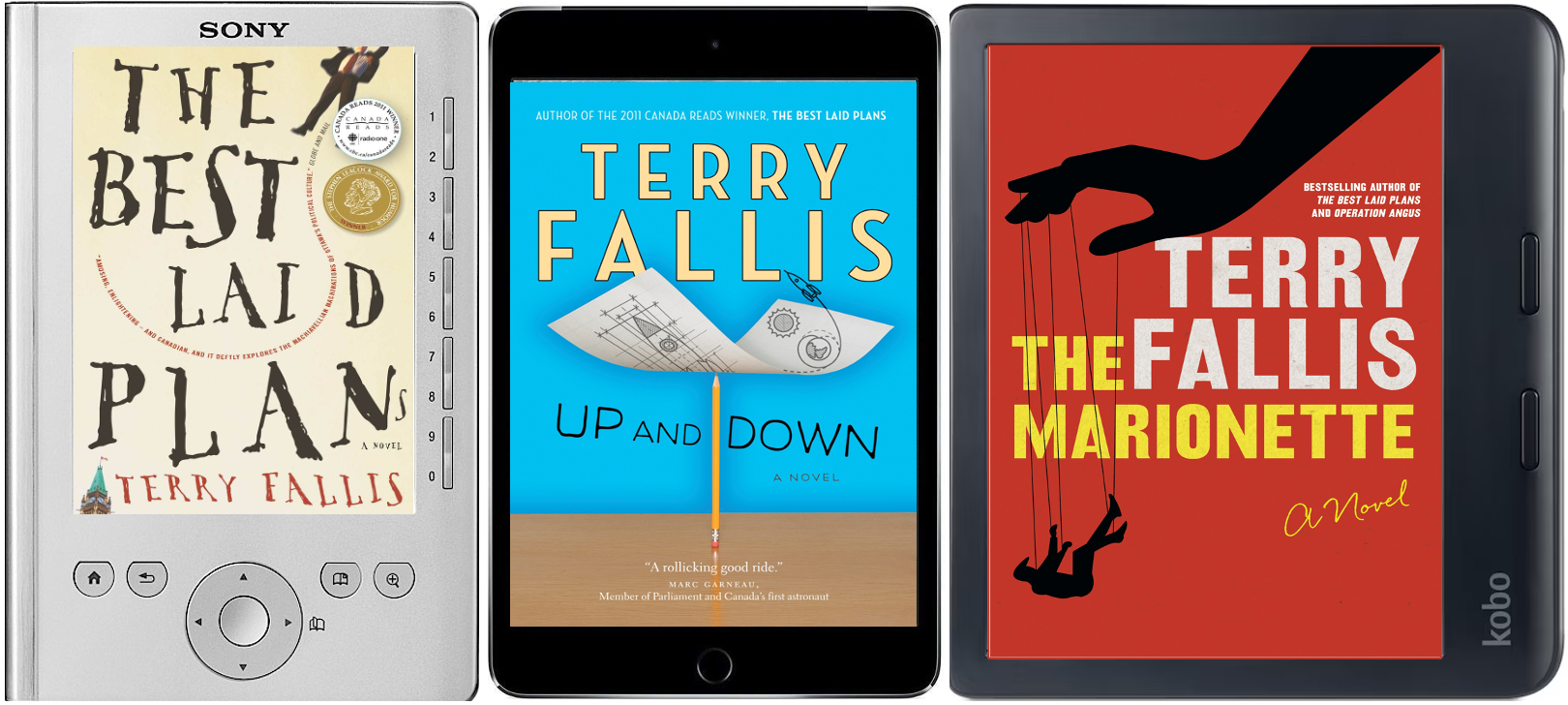
I was tempted to replace my broken Sony, but by that time (2010), I had an iPad and downloaded the Kobo app. So my ebook reading switched over to my iPad for the next fifteen years, including when I moved to the iPad Mini around 2014—the smaller form factor worked better for me. Then a couple years ago, I noticed my early morning iPad reading was leaving my eyes slightly red-rimmed. So last year, I actually returned to my E-reader roots and bought a Kobo Libra Colour, which relied on the tried and true E ink technology. I find the E ink is much easier on my eyes—and my new Kobo is backlit so I now can read at night without turning on a light. I love my Kobo. It’s so light and easy to operate. But I still also read on my iPad Mini, particularly manuscripts that I’m reading and then blurbing.
Do I prefer ebooks or real books?
Well, from 2008 to 2020 or so, I’d estimate that 75% of my reading was via ebooks with 25% being old school paper, cardboard, and glue. In the process, I discovered that for me, the message mattered more than the medium. In short, storytelling is storytelling whether through ink on paper, or E ink. I still fell into the story regardless of how I was reading it. Whether on screen or page, it seemed I consumed and appreciated the story in just the same way. I know that’s not the experience of all readers, but I found my experience of the storytelling was the same for ebooks or real books. Give me a good story in hardcover, trade paperback, E ink, a long scroll, or even etched in granite tablets, and I’ll read it.
I still read a lot of ebooks, but for me—as for a lot of readers, it seems—my preference has shifted back towards paper. I’d say in the last five years, the split is closer to 40% ebook and 60% real books. I discovered that I like turning the pages and smelling the paper, and more easily tracking my reading simply by inserting my bookmark. On ebooks, marking your progress is not as straight forward. And if you happen to nod off while depressing the page-turning button on your E-reader—and I’ve done that more than once—when you wake up, it can be a real challenge to find your place.
So that’s my ebook journey so far. But perhaps the more interesting question is…
How are ebooks doing?
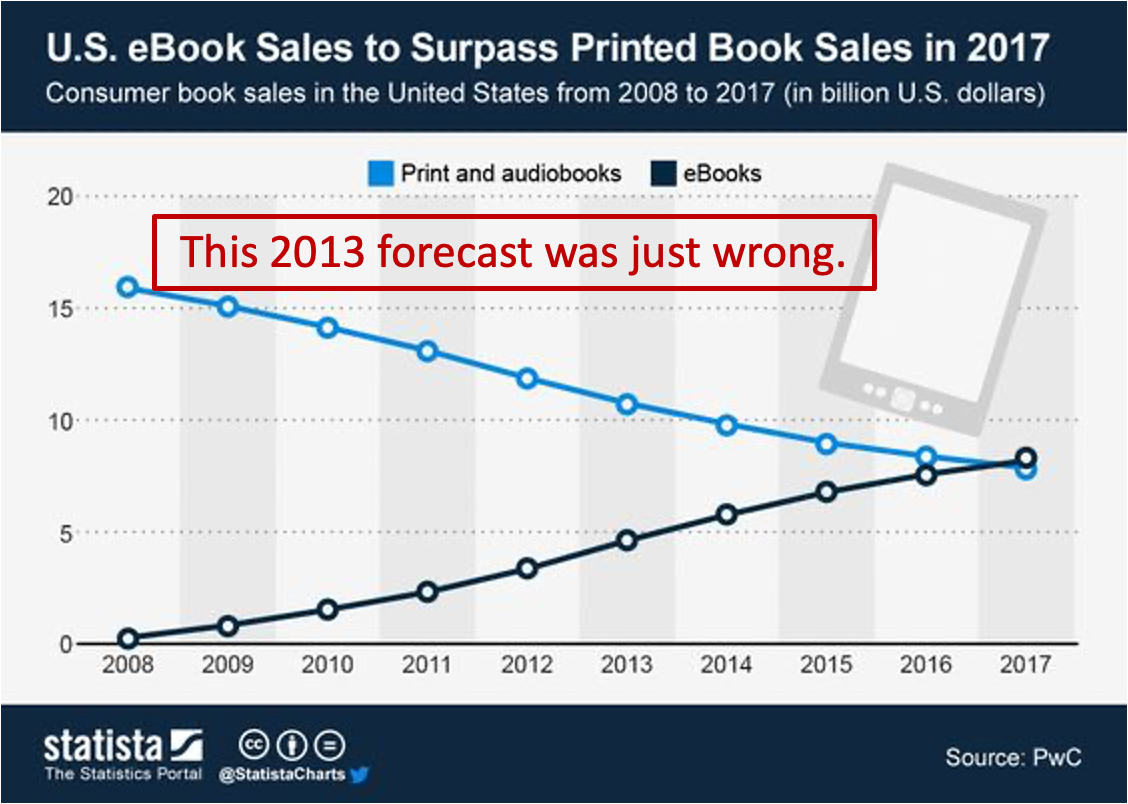
For the first few years of their existence (2008-2010), there was dramatic growth in the popularity of ebooks. Kindles, Kobos, iPads and other tablets were flying off the shelves and sales of ebooks were very strong. I can tell you that when Sony first launched their E-reader in Canada in 2008, publishers feared it might actually spell the end of physical books. In fact, one forecast from 2013 by Price Waterhouse Coopers projected that ebooks would surpass physical and audio books by 2017. Nope. That never happened.
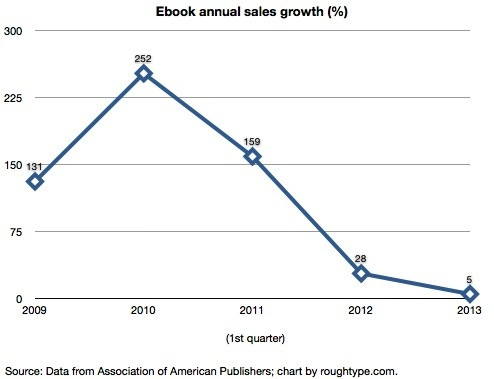
I’m not sure on what evidence Price Waterhouse Coopers based their prediction beyond the initial rapid growth, but ebook sales growth had slowed dramatically by 2013. As you can see by the graph below, the strong initial growth slowed and eventually flattened. For the first few years after E-readers hit the market, the growth in ebook sales was in the triple digits. But the growth started slowing in 2010 and by 2013 had fallen to 5% growth. (Note that the graph shows sales growth, not sales, so even in 2013, there was still growth in annual ebook sales (5%), just not at the torrid pace of 2009 and 2010.)
From 2013-2018 ebooks sales plateaued and even declined. Then the pandemic seemed to trigger a brief resurgence in ebook sales from 2019-2020, but that again plateaued in recent years. However, steady though very modest growth in ebooks is forecast for the coming years.
Reasons for the slow growth in ebook sales
Several factors come together to explain why ebooks have never fulfilled their initial promise. What happened? Here are a few thoughts:
The ebook market is now considered mature. Most hardcore readers have already purchased E-readers (e.g. Kindle, Kobo, iPad, etc.) so device sales have slowed.
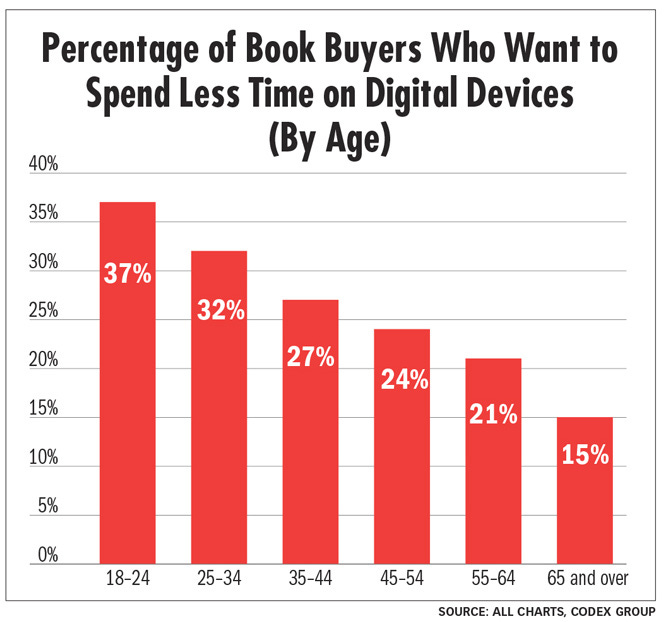
Screen fatigue is real. Public opinion research has confirmed that many of us want to reduce our screen time—I’d like to reduce the eyestrain that I attribute to too much time scrolling on my iPad.
When it comes to hardware, there have been very few new and compelling E-readers released in recent years.
People are returning to physical books. I think after the initial excitement of E-readers, many book lovers have returned to the tactile and sensory experience of turning real pages in real books.
Ebook prices are rising. According to Google, “in 2025, Canadian ebook prices have risen by 13%, a higher rate of increase than hardcovers (7%) and paperbacks (4%).” Anecdotally, as an ebook buyer, I can confirm the considerable growth in the price of ebooks in recent years. So why not pay a few dollars more and have a real book to put on your shelf?
My own book sales show a declining share for ebooks
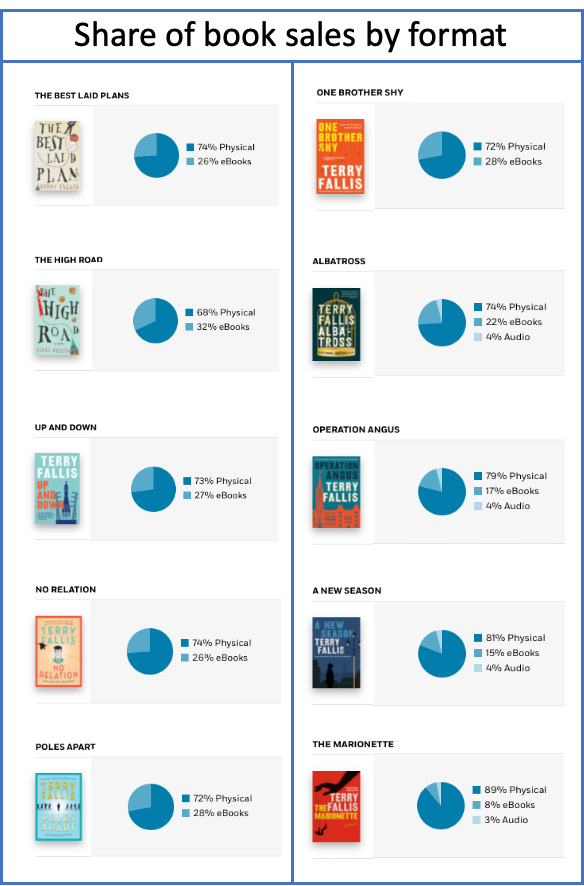
Here’s a summary of the share of book sales by format. As suggested earlier, there was an initial flurry in ebook sales growth. My debut novel, The Best Laid Plans was published in 2008, just as E-readers were hitting the market. All these years later, Ebooks currently represent 26% of cumulative sales of my debut novel. My follow-up novel, The High Road, in 2010 (the peak in ebooks sales growth) enjoys a cumulative ebook sales share of 32%. As you go down the two columns below, you’ll see a plateauing of ebook sales share at around 27% until 2015 when my sixth novel, One Brother Shy hit bookstores. After that, there’s been a steady decline in sales share for ebooks from 22% on my seventh novel, Albatross, to 8% for my tenth novel, The Marionette. Interesting. (Now it’s possible that as a book ages and perhaps is less available in physical form, readers turn to ebooks. So I’ll monitor what happens to my share of ebooks sales on my last couple of novels to see if it rises in the coming years.)
So much for the end of physical books!
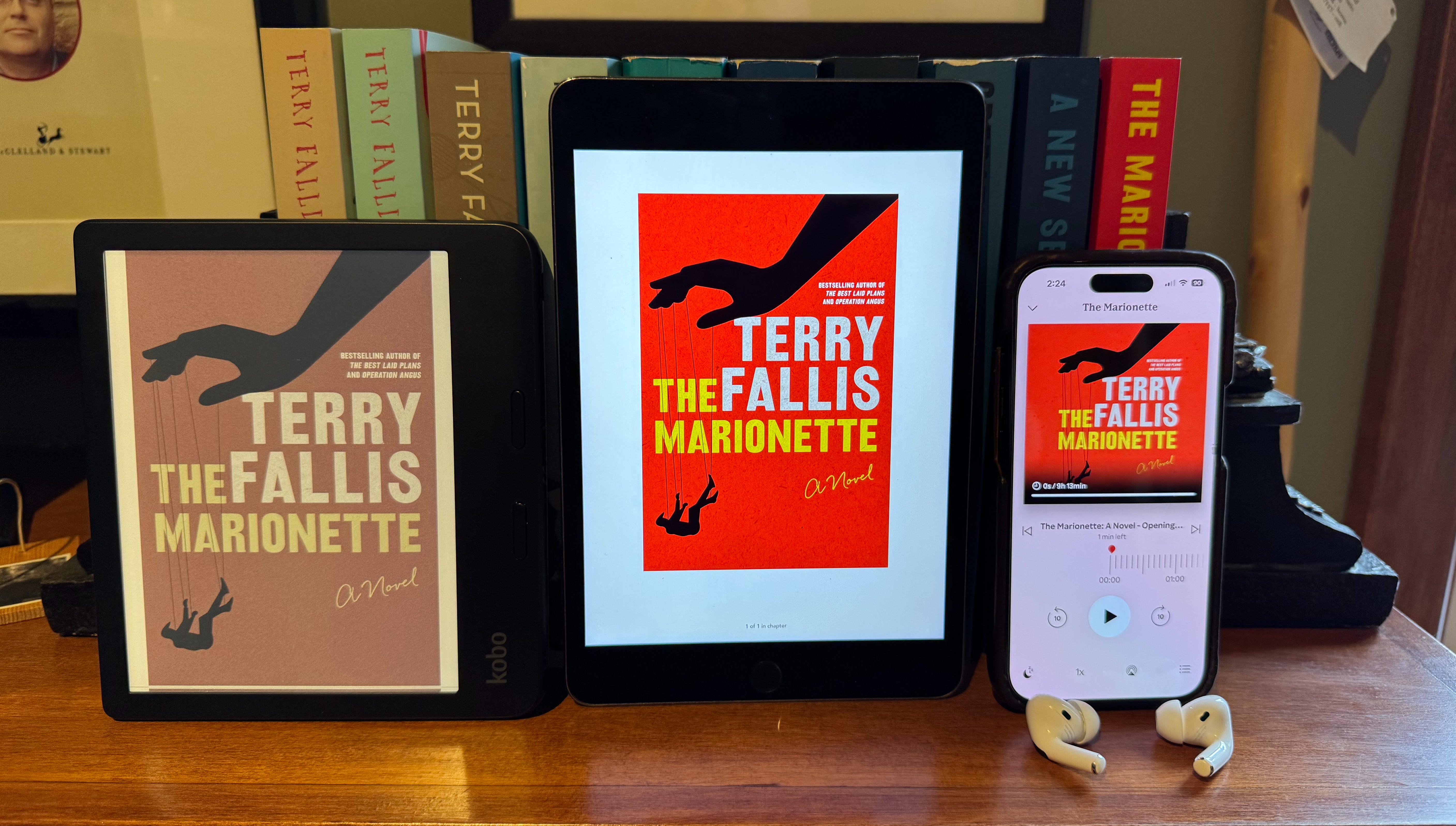
The initial fears that by 2025 most books would be read on electronic devices have not come to pass. The physical book is alive and well. I think there will always be a place in the market for physical books. Too many of us like the experience of holding a book and turning (and smelling) the pages. Having said that, I also believe that ebooks are now a fixture in the book market and provide book lovers with some real benefits including built-in dictionaries, the ability to highlight passages and make notes, the flexibility of carrying hundreds of books on a small device, not to mention being able to finish a book in the middle of the night, and then literally within seconds, buy the author’s next novel and start reading it.
I think after the initial disruption when E-readers first appeared, the market has settled, and matured, and most readers have acquired a preference for how they read. It seems clear that there is room in the book market for physical books, ebooks, and audiobooks (still the fastest-growing segment), giving readers more choice than we’ve ever had in the past.
I’ll continue to read books in all three of these categories, with the nature of the story itself often dictating which format I’ll choose. But I cannot foresee a day when you won’t find me settled onto our couch with a real book in my hands for the timeless pleasure of falling into a story and turning the pages until its ends.
Wrapping up…
Thanks for taking a gander at this. Here’s hoping you’ll subscribe—it’s free and easy—so you won’t miss future posts. Thanks so much and we’ll see you again in two weeks.
I have never been a fan of e-readers. Just another thing to break down. But give me a book that was my mother’s or grandmother’s and I feel them turning the pages with me.
Wow....I could have sworn they were more influential.